Buying a Townhome in Alexandria vs DC: What to Know
July 2, 2026
July 2, 2026
Wondering whether your next townhome should be in Alexandria or Washington, DC? It is a smart question, especially if you want a home that fits your daily routine, your design preferences, and your long-term plans. The right choice often comes down to how you want to live, what kind of streetscape feels right to you, and how comfortable you are with historic-home rules and upkeep. Let’s dive in.
If you are comparing Alexandria and DC, the first major difference is how each place feels block to block. Alexandria often reads as a smaller historic river city with a more cohesive townhome character, especially around Old Town. DC offers a broader range of neighborhood personalities, with rowhouses and townhomes shaped by different planning histories across the city.
In Alexandria, Old Town is the historic urban core and the city’s center since 1749. King Street remains a major commercial corridor, and much of Old Town sits within a National Register Historic District. The city also has several other historic districts, including the local Old & Historic Alexandria and Parker-Gray districts, which are regulated by the Board of Architectural Review.
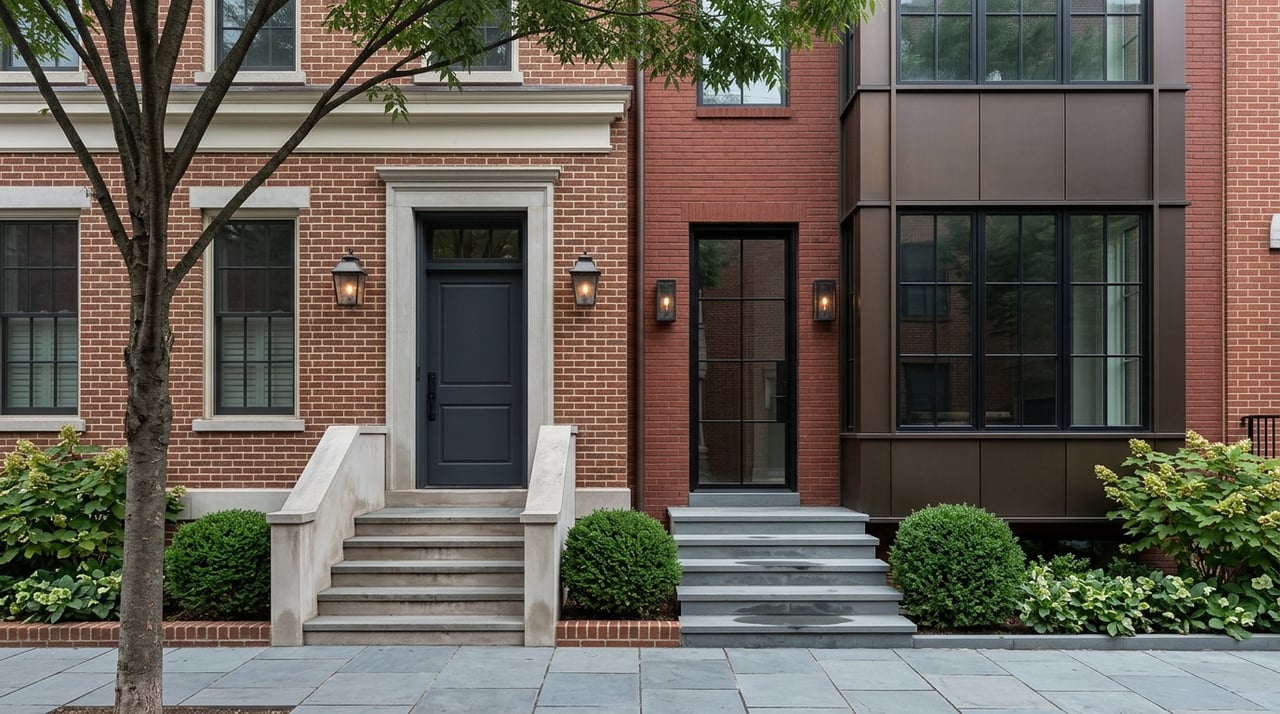
That history shows up in the housing stock. Alexandria is strongly associated with red-brick townhomes and architecture influenced by Georgian and Federal forms. In Parker-Gray, you also see small row houses and townhouses with late-19th-century Italianate and Queen Anne examples, along with twentieth-century brick Colonial Revival blocks.
DC’s townhome inventory is broader and more neighborhood-specific. The District’s rowhouse form remained a common housing type through much of the 19th and early 20th centuries, and the city includes more than 23,600 historic buildings across more than three dozen historic districts. That scale gives buyers far more variation in architecture, block style, and neighborhood atmosphere.
If you are drawn to a polished, historic-town setting, Alexandria may feel more intuitive. Many townhome streets there have a consistent visual rhythm, with brick facades, narrower blocks, and a close relationship to Old Town’s commercial spine and waterfront. The overall effect can feel intimate and established.
That does not mean every Alexandria townhome looks the same. The city’s historic districts add subtle variety, and neighborhoods like Parker-Gray offer different architectural eras and scales. Still, the market often feels more unified than what you will find across DC.
In DC, style can shift quickly from one neighborhood to the next. Ward 2 includes areas such as Georgetown, Foggy Bottom, Sheridan-Kalorama, Dupont Circle, Logan Circle, Mount Vernon Square, and Shaw, each with distinct townhouse character. Ward 6 centers on Capitol Hill, while Ward 1 includes rowhouse-dominant areas such as Columbia Heights, Adams Morgan, Mount Pleasant, and the U Street area.
For you as a buyer, that means more options in form and setting. You may find grand Victorian townhomes in one area, more classic Capitol Hill-style rowhouses in another, and a denser urban block pattern in another. If variety matters, DC usually gives you a larger menu.
One of the biggest practical differences in buying an older townhome is not what you see today. It is what you may or may not be able to change later.
In Alexandria’s local historic districts, the Board of Architectural Review must approve new construction and exterior alterations visible from a public way. Interior work does not require BAR approval. If you are thinking about window changes, facade updates, additions, or visible exterior work, this should be part of your due diligence from the beginning.
In DC, the Historic Preservation Review Board reviews exterior repairs, alterations, additions, and new construction on historic properties. Routine exterior maintenance is exempt from preservation review. As in Alexandria, these rules can affect how quickly and easily you can make visible changes.
A townhome can look move-in ready but still carry future limits that affect cost and flexibility. If you expect to expand, redesign the exterior, or make visible updates, you will want to confirm what approvals may be required. In both markets, historic status can shape not just aesthetics, but also timelines and project planning.
Not every townhome is a simple fee-simple purchase with no shared obligations. Some townhomes are part of a condominium or property owners’ association, and that can change both your monthly costs and your ownership experience.
In Virginia, buyers should review resale disclosure materials that may include a condominium resale certificate or an HOA disclosure packet. In DC condominium resales, the seller must provide condominium instruments and a certificate that includes items such as capital expenditures, reserves, and budget information. These documents matter because they help you understand rules, financial health, and potential future costs.
When you compare a townhome in Alexandria versus one in DC, ask for clarity on:
A beautiful townhome is only part of the picture. The ownership structure behind it can affect your monthly budget and your long-term flexibility.
Property taxes are another meaningful part of the Alexandria versus DC decision. They may not make the decision for you, but they should be part of the math.
As of FY 2026, Alexandria’s real estate tax rate is $1.135 per $100 of assessed value. In DC, the residential Class 1A rate is $0.85 per $100. Class 1B residential property with no more than two dwelling units is taxed at $0.85 per $100 on the first $2.558 million of assessed value and $1.00 above that.
A lower tax rate does not automatically mean a lower total cost, since assessed values and home prices differ by property. Still, this is an important side-by-side comparison when you are evaluating carrying costs. It is especially relevant if you are comparing higher-value townhomes where annual ownership costs can add up quickly.
For many buyers, the real choice is less about state lines and more about daily movement. How easily can you get to work, dinner, the airport, or a weekend train? That answer looks a little different in Alexandria and DC.
Alexandria is unusually transit-rich for a Virginia city. It has five Metrorail stations, a VRE station adjacent to King Street, DASH bus service connecting to Metrobus, Metrorail, and VRE, the free King Street Trolley between King Street Metro and Market Square, and Metroway BRT between Braddock Road and Pentagon City. King St-Old Town is also served by the Blue and Yellow lines and sits across from Alexandria Station, which serves Amtrak and VRE.
DC’s mobility advantage is density. The District has built over 100 miles of bike lanes since 2001, and Capital Bikeshare has more than 700 stations across the metro region. The Office of Planning also describes Center City as the center of the region’s transportation network.
Alexandria may appeal to you if you want strong rail access without being in some of the District’s densest blocks. In the right location, you can support a fairly car-light routine while still enjoying a smaller-scale setting. Old Town, in particular, blends rail, trolley, walking, and waterfront access in a way that feels distinct.
DC often works best if you want a denser neighborhood grid and more everyday trips done on foot, by bike, by bus, or by Metro. Many townhome areas are closely tied to commercial corridors and daily convenience. If your routine depends on being near multiple transportation options at once, DC can offer that in more neighborhoods.
Beyond architecture and commute, buyers usually respond first to atmosphere. Alexandria’s townhome lifestyle is often described as more intimate, historic, and waterfront-oriented. Old Town features shops, dining, parks, a marina, a waterfront promenade, wayfinding, and the King Street corridor, along with the free trolley and a strong pedestrian focus.
DC offers a more varied urban-neighborhood experience. Ward 2 combines Downtown, Georgetown, Dupont Circle, and Foggy Bottom. Ward 6 centers on Capitol Hill and local commercial corridors. Ward 1 mixes historic townhomes with active restaurant and nightlife districts.
Alexandria may be the stronger fit if you want:
DC may be the stronger fit if you want:
If you are seriously comparing a townhome in Alexandria with one in DC, focus on the practical questions that shape daily life and future costs.
Ask whether the property sits in a local historic district and what exterior work would require approval. Confirm whether there is an HOA or condominium structure and review the budget, reserves, and rules carefully. Think through how walkable, bikeable, rail-based, or car-based your daily routine will be in each location.
Just as important, pay attention to feel. Some blocks will feel like a preserved small city, while others feel more like a dense urban neighborhood. Neither is better on its own, but one may fit you better.
If you want a thoughtful, neighborhood-specific comparison instead of a one-size-fits-all answer, Nelson Marban can help you weigh the details and find the townhome that truly fits your lifestyle and goals.
Get assistance in determining current property value, preparing your property for sale, crafting a competitive offer, negotiating a contract, and much more. Contact me today.