Potomac MD Estate Homes: What Sets Them Apart?
May 7, 2026
May 7, 2026
Wondering what actually makes a home an estate home in Potomac? You are not alone. The term sounds official, but in Potomac it usually describes a certain kind of property experience rather than a formal county label. If you are buying, selling, or simply trying to understand the local luxury market, this guide will show you what the estate label really means in Potomac and how to recognize it. Let’s dive in.
In Potomac, an estate home is not a separate legal housing category. Montgomery County instead uses estate-style residential zoning such as RE-1 and RE-2 for large-lot detached housing.
That matters because the word “estate” is mostly market shorthand. In practice, buyers and sellers use it to describe homes with more land, more privacy, larger scale, and room for features that go beyond a standard suburban property.
The clearest foundation for an estate-style home in Potomac is lot size. Montgomery County’s RE-2 zone is intended for large-lot residential use with a 2-acre minimum lot area, while RE-1 requires 40,000 square feet.
These zones are built around detached homes, generous setbacks, and low-density site planning. In simple terms, that means the land itself often helps define the estate feel before you even step inside the house.
If you are trying to spot a true estate property in Potomac, start with the lot. A home on roughly 2 acres or more usually fits the strongest version of the estate profile, especially in areas where RE-2 zoning appears.
That does not mean smaller luxury homes cannot feel impressive. But in Potomac, acreage is often what separates a high-end home from a property the market tends to describe as an estate.
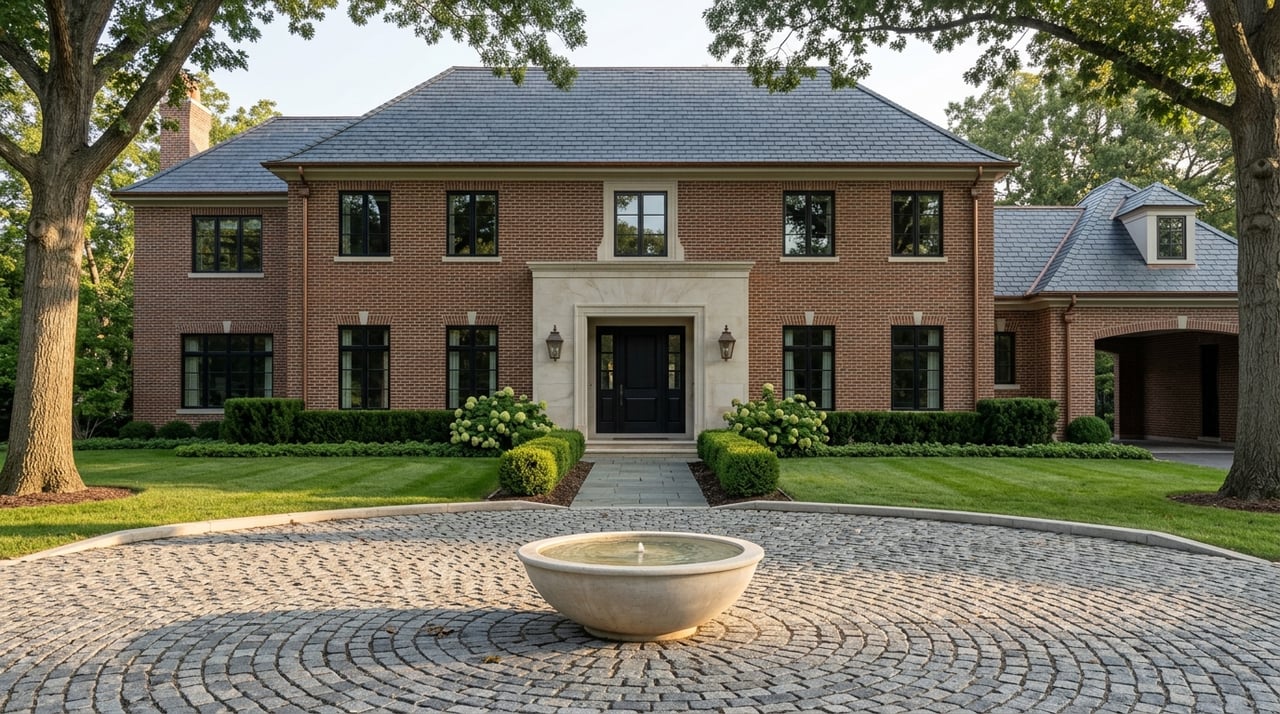
Estate homes usually offer more than square footage. They often come with long driveways, mature trees, broad lawns, and a sense of separation from neighboring homes.
That private setting is part of why Potomac fits the estate-home conversation so well. The area evolved from rural and agricultural roots into a semi-rural and suburban community while retaining green character and environmental qualities, according to Montgomery Planning.
Another major factor is housing type. Potomac estate homes are generally detached single-family residences, not attached or higher-density formats.
That matches the county zoning framework, which emphasizes detached houses and larger site layouts. So when people talk about estate homes in Potomac, they are usually talking about standalone properties with room to breathe.
One reason the estate label carries weight in Potomac is that these larger properties may support substantial accessory uses. County rules in estate-style zones explicitly contemplate accessory structures and even animal-related structures.
That helps explain why barns, stables, detached garages, and similar service buildings can fit the local pattern. These features are not required, of course, but they are part of the reason some properties feel distinctly estate-like.
When buyers search for estate-style homes in Potomac, they are often looking for a specific set of features. Public market search categories in Potomac commonly highlight big yards, big lots, swimming pools, horse stables, libraries, wine cellars, basketball courts, and no-HOA options.
Visible markers matter too. Mature landscaping, a long approach from the road, outdoor entertaining space, and room for detached structures all reinforce the estate identity.
Some buyers assume every estate property includes a guest house. In Potomac, that is not the norm based on current public inventory.
In fact, public search results currently show guest houses as a niche feature rather than a standard one. So if a guest house is on your must-have list, it is smart to treat that as a specialized search criterion rather than an assumed estate-home feature.
Potomac’s broader housing profile helps explain why the estate label is so common here. The Potomac CDP covers 25.13 square miles, had 47,018 residents in 2020, and reported an owner-occupied housing rate of 84.8%.
The median value of owner-occupied housing units in Potomac was $1,157,000 in 2020 through 2024. That sits far above Montgomery County’s $640,300 median, which shows how firmly Potomac is positioned in the county’s upper-tier housing market.
Recent public market trackers also show Potomac in a strong luxury price band. Redfin reported a March 2026 median sale price of about $1.215 million, Zillow reported a median sale price of $1.343 million, and Realtor.com reported a median listing price of $1.225 million.
Those figures are helpful, but they do not define estate homes on their own. In Potomac, the estate label usually starts well above the county median and rises quickly with acreage, custom construction, and upgraded amenities.
This is where buyers sometimes get confused. A luxury home in Potomac may be expensive, but that alone does not make it an estate property.
The stronger signal is the combination of price plus land, privacy, and scale. Current public listings show this clearly, with homes on roughly 2.06 to 2.46 acres priced around $2.85 million to $4.2 million, along with a 10.68-acre listing at $4.1 million.
Not every part of Potomac presents the same estate feel. A few areas and community types help illustrate the differences within the local luxury market.
Understanding those distinctions can help you search more strategically or position your home more effectively if you are planning to sell.
Potomac Falls is one of the clearest examples of a true estate enclave. Its HOA describes the neighborhood as having 263 homes on minimum 2-acre lots with tree-lined streets and proximity to Potomac Village.
That lot pattern strongly matches what many buyers picture when they think of estate living. Larger parcels, consistent spacing, and established landscaping create a more classic land-rich estate setting.
Avenel represents a different side of Potomac luxury. Its community association describes roughly 900 luxury homes with golf-course proximity, a pool, tennis facilities, pickleball, and landscaped walking paths.
Avenel is certainly upscale, but it illustrates an important point: luxury and estate are related, yet not always identical. Some buyers want acreage and privacy, while others prefer high-end homes with shared amenities and a more structured community environment.
If you want a strong example of today’s estate-style inventory, the Piney Meetinghouse and Glen Road corridor stands out. Recent and active listings in that area show RE-2 zoning, 2-acre lots, homes on 2.07 and 2.45 acres, and estate-ready land over 2 acres.
That combination of zoning, lot size, and available inventory makes this corridor one of the most useful reference points for understanding Potomac’s estate market right now.
Potomac sits in a similar broad price band to some close-in Montgomery County luxury markets. Recent median sale prices were roughly $1.22 million in Bethesda and $1.27 million in Chevy Chase, putting Potomac in comparable company.
At the same time, Potomac generally prices below some of the priciest estate-oriented DC-area markets on current public trackers. McLean showed a March 2026 median sale price of $1.633 million, while Great Falls was at $2.038 million, with a median listing price of $2.275 million.
If you are shopping for an estate home in Potomac, focus on the fundamentals first. Look at lot size, zoning context, privacy, detached scale, and whether the site can support the lifestyle features you want.
It also helps to separate luxury features from estate characteristics. A beautiful home with premium finishes may be a top-tier luxury property, but the estate label usually becomes more convincing when the land and setting support it.
If you own a larger property in Potomac, your home may deserve more nuanced positioning than simply “luxury.” Buyers in this segment are often evaluating acreage, privacy, accessory structures, and overall site utility just as closely as interior finishes.
That means your pricing and marketing should reflect the full property story. The strongest estate-home presentation highlights not just the residence, but also the setting, scale, approach, and possibilities the land creates.
In Potomac, estate home is best understood as a market description, not a legal designation. The term usually points to large-lot detached housing with privacy, custom scale, mature landscape, and a price premium that reflects both the home and the land.
For many buyers, the clearest signals are RE-1 or RE-2 style settings, especially properties with substantial setbacks and room for accessory uses. In a market as layered as Potomac, understanding that difference can help you make smarter decisions whether you are buying or selling.
If you are evaluating a Potomac property and want a more precise read on how it fits within the local luxury and estate market, Nelson Marban can help you assess the home’s position, pricing, and buyer appeal with a neighborhood-specific strategy.
Get assistance in determining current property value, preparing your property for sale, crafting a competitive offer, negotiating a contract, and much more. Contact me today.